If you run a small business in Clarington, Bowmanville, Courtice, or nearby Durham Region, you probably care about one simple thing:
Can local customers find you when they need what you offer?
That is where local SEO comes in.
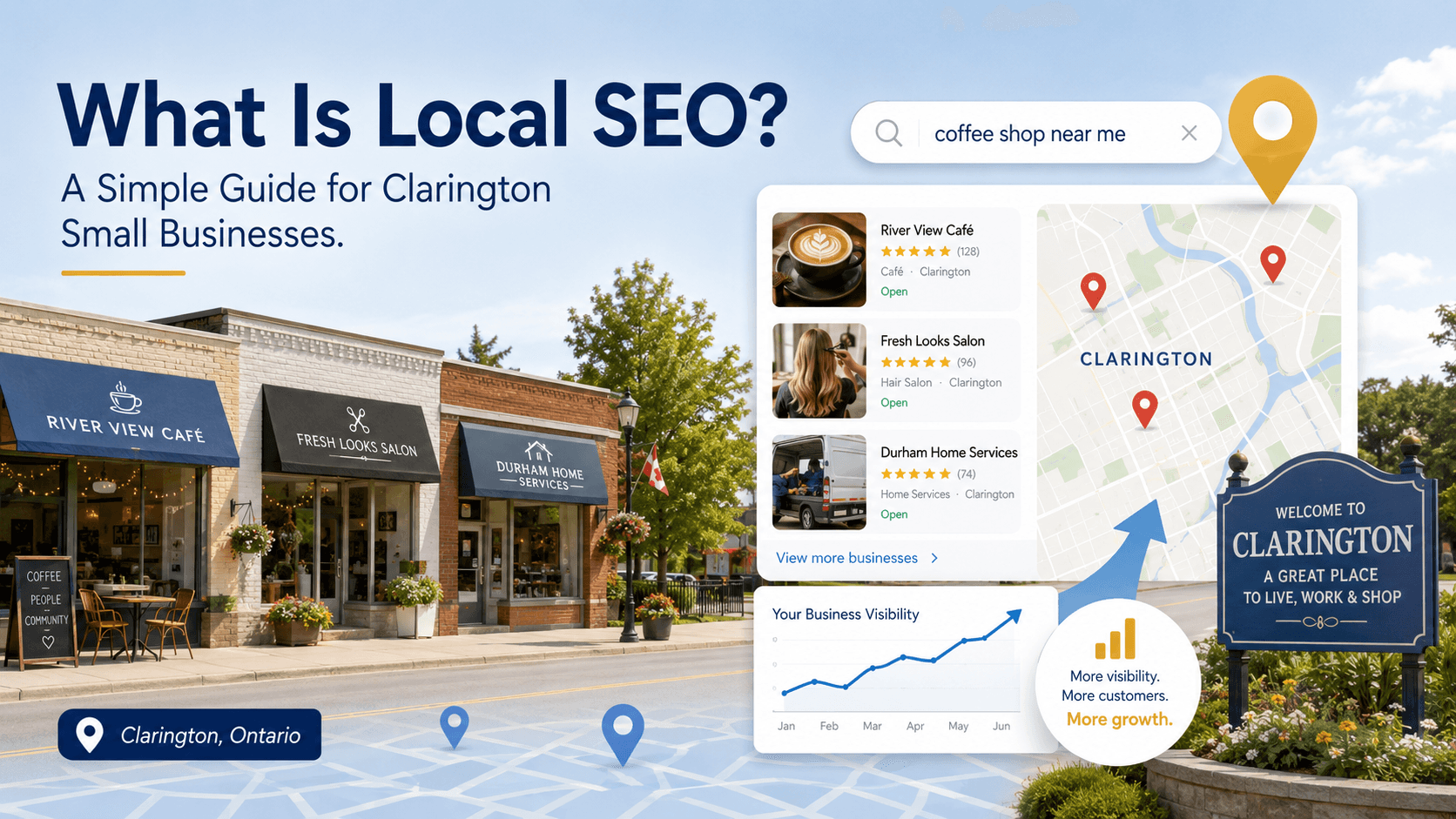
Local SEO helps your business show up more clearly when people search for nearby services, products, or organizations. It is especially important for businesses that serve a specific area, such as contractors, cafés, clinics, salons, consultants, nonprofits, churches, and professional services.
This guide explains what local SEO means, why it matters, and what small businesses in Clarington can do to improve their online visibility.
What is local SEO?
Local SEO stands for local search engine optimization.
In simple terms, it means improving your online presence so people in your area can find your business more easily when they search online.
For example, someone might search:
- “roof repair Bowmanville”
- “hair salon Courtice”
- “bookkeeper near me”
- “restaurant in Clarington”
- “website designer Durham Region”
- “church near me”
- “local SEO service Clarington”
Local SEO helps search engines understand:
- What your business does
- Where your business is located or where you provide service
- Who your business helps
- How people can contact you
- Whether your business looks active, trustworthy, and relevant
It is not only about adding keywords to a website. It is about making your business easier to understand, easier to trust, and easier to contact.
Why local SEO matters for Clarington businesses
Clarington is not downtown Toronto. Many local businesses rely on nearby customers, word of mouth, community trust, and local reputation.
That makes local SEO especially important.
When someone in Bowmanville, Courtice, Newcastle, Oshawa, or Whitby searches for a service, they often want a business that feels local, reachable, and relevant to their area.
If your business does not show up clearly online, potential customers may never know you exist. Even if they hear your name from a friend, they may still check your website or Google Business Profile before contacting you.
A strong local online presence can help people answer questions like:
- Is this business still active?
- Do they serve my area?
- What exactly do they offer?
- Can I trust them?
- How do I contact them?
- Do they look professional?
Good local SEO supports all of these questions.
Local SEO is not just about Google rankings
Many people think SEO only means “getting to number one on Google.”
That is too narrow.
For a small local business, local SEO is really about being easier to find and easier to choose.
That can include:
- Your website
- Your Google Business Profile
- Google Maps visibility
- Local service pages
- Reviews and reputation signals
- Business directories
- Social profiles
- Consistent business information
- Clear contact options
- Mobile-friendly website design
A business may not rank first for every keyword, but it can still improve its visibility, trust, and inquiries by making these pieces stronger.
No honest SEO provider should guarantee a number-one ranking. Search results depend on many factors, including competition, distance, relevance, website quality, content, reviews, and Google’s own systems.
But a business can still do many practical things to improve its local search foundation.
The three main parts of local SEO
Local SEO can feel confusing, but most of it comes down to three areas.
1. Your website
Your website should clearly explain who you are, what you do, where you serve, and how people can contact you.
For local SEO, your website should usually include:
- Clear service pages
- Local area references
- Fast loading speed
- Mobile-friendly design
- Simple navigation
- Strong page titles and descriptions
- Contact information
- Calls to action
- Helpful content
- Internal links between related pages
For example, a contractor in Courtice should not only say “we provide quality work.” The website should clearly explain the specific services offered, the areas served, and what a customer should do next.
Search engines need clarity. Customers need clarity too.
2. Your Google Business Profile
For many local businesses, Google Business Profile is one of the most important online assets.
It can appear in Google Maps and local search results. It may be one of the first things potential customers see.
Important Google Business Profile basics include:
- Correct business name
- Accurate category
- Clear business description
- Service areas
- Opening hours
- Phone number
- Website link
- Photos
- Services
- Reviews
- Regular updates when appropriate
Your Google Business Profile and website should support each other. If your profile says one thing and your website says another, it can create confusion.
The goal is consistency.
3. Your wider online presence
Search engines and AI tools do not only look at your website. They may also consider other places where your business appears online.
That can include:
- Local business directories
- Chamber of commerce listings
- Community organization pages
- Social media profiles
- Review platforms
- News mentions
- Event pages
- Partner websites
For Clarington and Durham Region businesses, local references can matter. A business that is consistently described across several trustworthy local sources may be easier to understand than a business with scattered or incomplete information.
This does not mean you need to be everywhere. It means the important places should be accurate and consistent.
What should a small business website include for local SEO?
A local business website does not need to be huge. But it should be clear.
At minimum, it should answer:
- What do you offer?
- Who do you help?
- Where do you serve?
- What makes you a good fit?
- How can people contact you?
- What should visitors do next?
A strong local business website often includes:
- Homepage
- Services page
- Individual service pages, if needed
- About page
- Contact page
- Service area information
- FAQ section
- Testimonials or project examples, if available
- Helpful resources or articles
For example, a small business serving Clarington, Bowmanville, and Courtice should make those service areas visible in natural, useful ways. This should not be keyword stuffing. It should simply reflect the real areas the business serves.
What is Google Business Profile optimization?
Google Business Profile optimization means improving your Google listing so it is more complete, accurate, and useful.
This may include:
- Choosing the most accurate primary category
- Adding relevant services
- Writing a clear business description
- Uploading good photos
- Adding service areas
- Checking hours and contact information
- Linking to the right website page
- Encouraging real customers to leave honest reviews
- Responding professionally to reviews
- Posting updates when useful
For many small businesses, this is one of the first places to start.
A weak or incomplete Google Business Profile can make a business look less active, even if the business itself is excellent.
What is the difference between regular SEO and local SEO?
Regular SEO often focuses on ranking for broader topics or national searches.
Local SEO focuses on searches with local intent.
For example:
“How to choose kitchen cabinets”
“benefits of massage therapy”
“small business website cost”
“kitchen cabinet installer Bowmanville”
“massage therapist Courtice”
“web design Clarington”
Local SEO is more location-specific. It connects services with places.
That is why service areas, local wording, Google Business Profile, and business information consistency matter so much.
How long does local SEO take?
Local SEO is not instant.
Some improvements can help quickly, such as fixing incorrect business information, improving website clarity, or completing a Google Business Profile.
Other improvements take longer, especially if the market is competitive.
The timeline depends on:
- How strong your current website is
- How complete your Google Business Profile is
- How competitive your industry is
- How many local competitors already have strong SEO
- Whether your business has reviews and local mentions
- How much useful content your website has
- Whether your site is technically healthy
For many small businesses, the first goal should not be “rank first immediately.” The first goal should be to build a stronger foundation.
A stronger foundation makes future marketing easier.
What local SEO tasks can you do first?
If you are just starting, focus on the basics.
Here are practical first steps:
- Search your business name on Google and see what appears.
- Check that your Google Business Profile is accurate.
- Make sure your website clearly says what you do and where you serve.
- Add or improve your service pages.
- Make your phone number, email, or contact form easy to find.
- Check your website on a phone.
- Make sure your business name, address, phone, and website are consistent across major profiles.
- Ask satisfied customers for honest reviews.
- Add helpful local content to your website.
- Avoid unrealistic SEO promises or shortcuts.
These steps are not flashy, but they matter.
What about AI search visibility?
Search is changing.
More people are starting to use AI-powered tools to ask questions, compare options, and look for recommendations. This does not replace Google, but it does change how businesses should think about online visibility.
AI search tools need clear information. They are more likely to understand a business if its website and online profiles clearly explain:
- Business name
- Location
- Service areas
- Services offered
- Ideal customers
- Contact information
- Unique positioning
- Helpful explanations
- Consistent descriptions across the web
This is why local SEO and AI search visibility are connected.
A business with a clear website, consistent profiles, useful content, and local relevance is better prepared for both traditional search and AI-powered discovery.
For a deeper plain-language overview, explore AI search visibility and GEO readiness support.
For small businesses in Clarington, this is a good time to build that foundation before the market becomes more crowded.
Common local SEO mistakes
Many small businesses do not have a local SEO problem because they are doing something “wrong.” They simply have unclear or incomplete online information.
Common issues include:
- Website does not clearly say what the business does
- Service areas are missing or vague
- Contact information is hard to find
- Google Business Profile is incomplete
- Website is slow or difficult on mobile
- Services are all listed on one vague page
- No clear call to action
- Old business information appears in directories
- The website looks inactive
- No helpful local content
- Too much focus on design, not enough focus on clarity
A beautiful website can still underperform if visitors cannot quickly understand the business.
Good local SEO starts with clarity.
Do you need a monthly SEO retainer?
Not always.
Some businesses do need ongoing SEO work, especially in competitive industries.
But many small local businesses should begin with a practical visibility review and foundation cleanup before committing to a large monthly retainer.
That may include:
- Website review
- Google Business Profile review
- Basic keyword and service-area check
- Page title and metadata improvements
- Local content suggestions
- Contact flow improvements
- Technical website cleanup
- Simple action plan
After that, the business can decide whether ongoing SEO support makes sense.
For some businesses, a focused one-time improvement project may be more realistic than a long-term contract.
Local SEO checklist for Clarington small businesses
Here is a simple checklist:
- Your website clearly explains your services
- Your homepage mentions your real service area
- Your contact information is easy to find
- Your website works well on mobile
- Your Google Business Profile is complete
- Your business category is accurate
- Your services are listed on your Google profile
- Your business information is consistent online
- Your website has useful service pages
- Your pages have clear titles and descriptions
- You have a plan to collect honest reviews
- You avoid fake reviews and ranking guarantees
- You have at least some helpful local content
- Your website gives visitors a clear next step
If several of these are missing, local SEO can probably help.
Final thoughts
Local SEO is not about tricking Google.
It is about helping people and search engines understand your business more clearly.
For Clarington small businesses, that means having a clear website, a complete Google Business Profile, consistent business information, useful local content, and a simple path for customers to contact you.
The businesses that do this well are easier to find, easier to understand, and easier to trust.
If your website exists but is not helping enough people find or contact your business, a local visibility review is a practical place to start.
Explore Durham Digital Services' local SEO and AI search readiness support for a practical overview of the service.